

Sade has lived in Detroit her entire life. It’s where she grew up, where she built her family, and where she learned, often the hard way, how to stand on her own. Her story doesn’t start with homelessness—it starts with independence.
She was adopted as a child and grew up with siblings who were older than her, many of whom lived in Philadelphia. While they stayed connected, Sade describes their relationships as complicated. There were expectations placed on her, opinions about how she should live, and a constant feeling of being guided, or controlled by others. “I’ve always been the type to do my own thing,” she says. “I don’t like being controlled.”
That mindset followed her into adulthood and shaped how she raised her own children. For Sade, being a mother meant making decisions based on what worked for her household—not what others thought she should do.
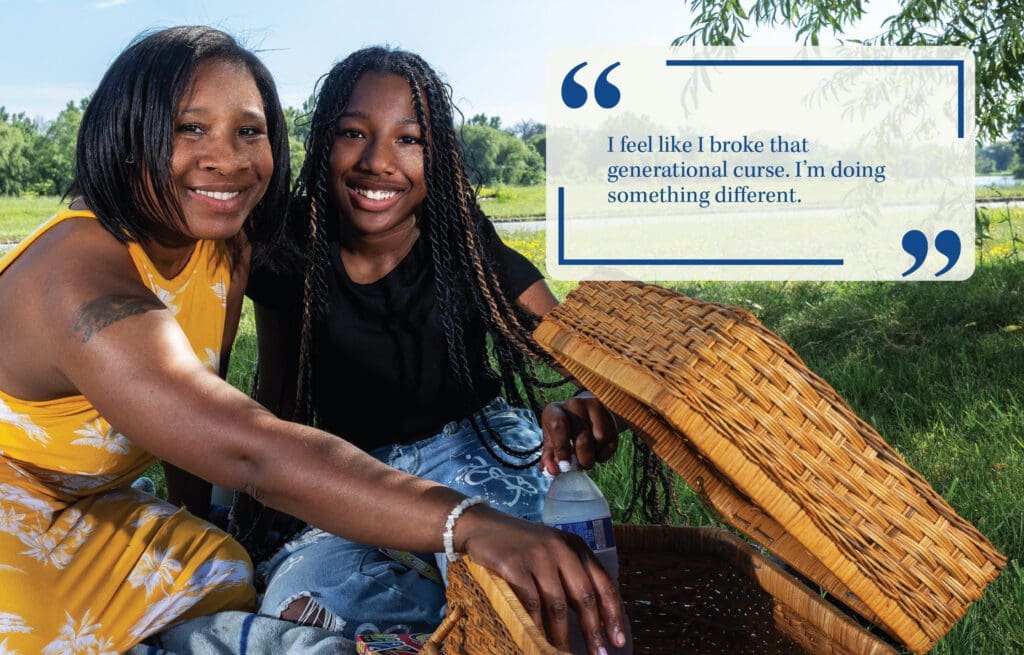
At the same time, she was very aware of the patterns she came from. Addiction, instability, and generational cycles were part of her family history. Breaking those cycles became personal. “I feel like I broke that generational curse,” she explains. “I’m not on drugs. I didn’t have my child young. I’m doing something different.”
Sade’s experience with homelessness didn’t come from one sudden event. It came from a situation many families can relate to, being in a relationship that didn’t work out. When the relationship ended, she was left carrying everything on her own. Bills, responsibilities, and her children, all without the financial support she once had. “I was stuck with the bills, and I couldn’t afford it by myself,” she says.
She tried to find another place. She looked for options. But everywhere she turned, she was told the same thing: go to a shelter. At first, she resisted. “I kept asking, why is that the only option?” But after hearing it over and over again, she began to see it differently. “I believe in signs,” she says. “And it kept coming back to that.”
Eventually, she made the decision to enter a shelter—even though it wasn’t what she wanted. Before going through it herself, Sade had a very specific idea of what homelessness looked like. “I used to think it meant being on the street, under bridges, with nothing,” she says. What she found was different. At COTS, she had a room, a bed, and access to support. But that didn’t mean it was easy.
She entered during the pandemic, when isolation made everything harder. Families were confined to their rooms. There was little movement, little connection, and a lot of emotional weight. “That time… months felt like years,” she says.
She also found herself dealing with depression, something she hadn’t experienced in that way before. Therapy became part of her support system, along with people she met through church. But the biggest source of strength came from someone unexpected. Sade had one of her daughters with her in the shelter, and during some of her lowest moments, it was her child who lifted her up. “She would tell me, ‘Mama, it’s going to be okay. We’re going to get a house,’” Sade recalls. Those moments stayed with her.
While Sade worried about how the experience would affect her children, she saw something different in them: resilience, adaptability, and strength. Her daughter didn’t define herself by the situation. She kept going to school, staying connected, and moving forward. “That’s not her whole life,” Sade says. “She still has a future.”
Sade describes herself now as a “homelessness survivor.” It’s been six months since she left shelter, and she’s focused on what comes next. Her growth wasn’t just about getting out, it was about what she learned while she was there. She talks about accountability. About learning from her mistakes. But one of the biggest shifts for her was understanding forgiveness. “I had to learn what forgiveness really means,” she says. “It’s not for the other person—it’s for you.” That shift changed how she saw her past, her relationships, and herself.
Sade is also very direct about how people misunderstand homelessness. “It’s not what people think,” she says. She explains that many people assume homelessness is the result of bad choices or a lack of effort. But her experience showed her something different, how quickly circumstances can change, and how limited the options can be. “People don’t understand how hard it really is,” she says. She also points out the bigger barriers, rising rent, low wages, and systems that don’t always make it easy to move forward.
Now, Sade is focused on stability, on building something that lasts. Her main goal is to buy a home. “I want something nobody can take from me,” she says. For her, homeownership isn’t just about having a place to live. It’s about security, independence, and creating something her children can rely on. She’s also focused on growing financially; working, building multiple streams of income, and stepping away from systems that limit her potential. “I don’t want to be stuck,” she says.

One of the biggest changes in Sade’s life is how she chooses to move now. She’s more protective of her peace. More intentional about her relationships. And more confident in saying no. “If I don’t feel good around you, I don’t need to be around you,” she says. She describes herself as someone who values happiness, freedom, and authenticity, things she didn’t always prioritize before. “I know who I am now,” she says. “And I love me.”
Sade doesn’t see her story as finished. She sees it as something she can use to help others. She talks about sharing information, supporting others going through similar situations, and being honest about the journey. “I just want my story to help somebody else get through it,” she says.
And for her, that’s what moving forward looks like—not just building a better life for herself, but making sure someone else knows they can do the same.
You’re invited to tune in and hear more of Bianca’s story on The Art of Family Podcast. https://bit.ly/SpotifyPcasts-AoF